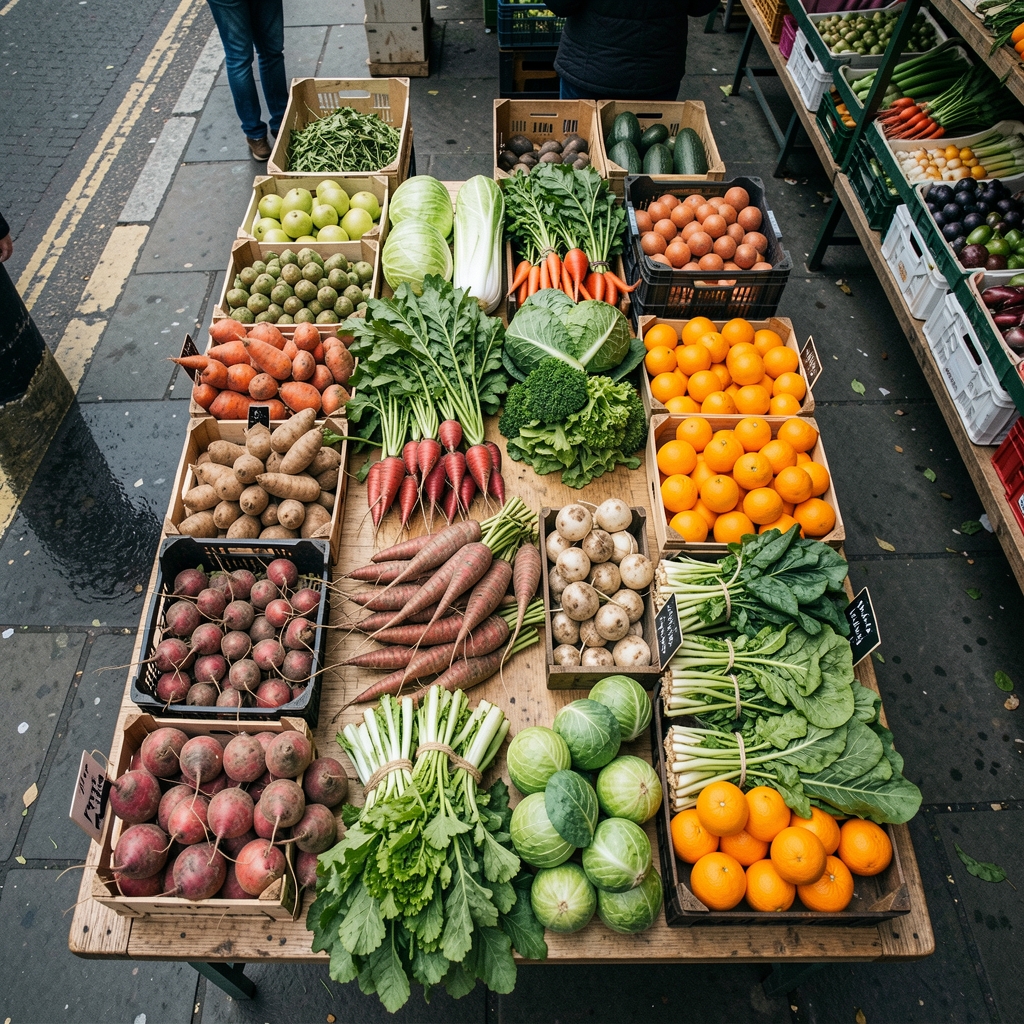
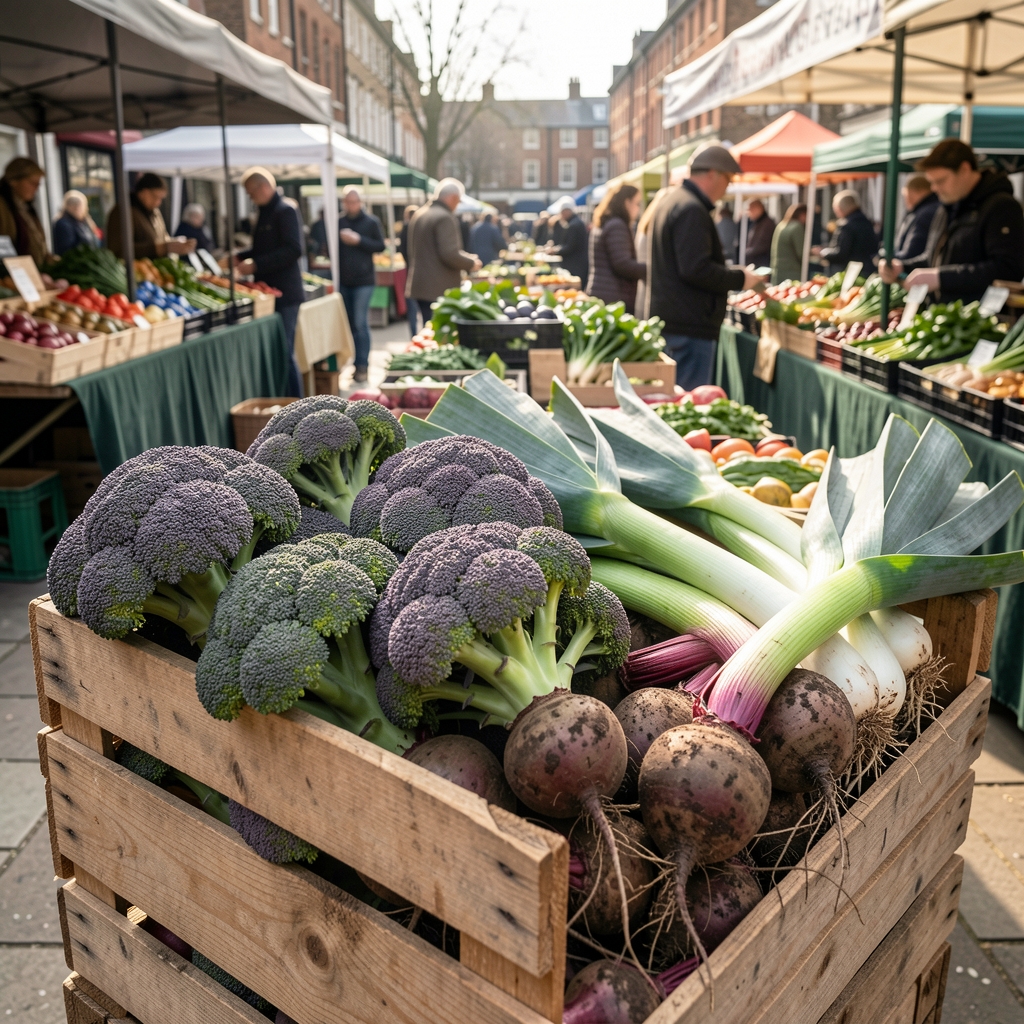
London, March 2026 — The Saturday market near Exmouth Square maintains its stalls through winter and into early spring with a particular stubbornness. In January, the crates hold celeriac, stored squash, leeks, and dark-leafed brassicas. In late February, the first purple sprouting broccoli and some muddy forced rhubarb appear. This transition — witnessed each week on the same route home — is the basis for what follows: a set of notes on how the seasonal calendar shapes a balanced eating practice.
The Market as Weekly Anchor
There is a case to be made — and it has been made, repeatedly, in the broader literature on food practice — that a weekly market visit functions as more than a procurement exercise. It establishes a rhythm. The act of walking the stalls, noting what is available, selecting on the basis of quality and seasonal appropriateness rather than habit or convenience, constitutes a form of attention that shapes the eating week before it begins.
Over several months of documented market visits, a pattern emerges in the selections: the winter months skew heavily toward root vegetables and robust brassicas — parsnips, beetroot, celeriac, cavolo nero, Savoy cabbage. Spring introduces tenderness: asparagus from Worcestershire growers beginning in April, early salad leaves, radishes, and peas in the pod. Each shift in the available produce necessitates a corresponding shift in the week's cooking — not as a chore but as a natural recalibration. What the market offers structures the plate.
This structure has a nutritional dimension that bears noting. Seasonal vegetables, consumed at or near their point of harvest, tend to carry higher concentrations of certain micronutrients than their stored or travelled counterparts. The argument is not absolute — storage methods have improved considerably, and supply-chain produce retains much of its nutritional value in most circumstances. But the repeated observation, noted in long-running dietary studies rather than short-term interventions, is that households with strong vegetable diversity across the year tend to exhibit broader nutritional coverage simply by following what is available in season.
The Winter Table and Its Particular Logic
The winter months present the most clearly documented case for planned, whole-food cooking. The available produce is not glamorous — parsnips and swede do not photograph as attractively as summer tomatoes or ripe stone fruit — but it is well-suited to the kinds of sustained, slow-cooked preparations that generate large quantities of ready food from modest effort. A pot of root vegetables, roasted on Sunday with good olive oil and herbs, yields material for four to five days of balanced lunches. A large batch of lentil stew requires perhaps forty minutes of active preparation and sustains a household through the better part of a working week.
The winter table has its own nutritional profile: it is dense with fibre from the roots and legumes, relatively low in simple sugars, and — when structured around whole grains — consistent with the dietary patterns associated with stable weight management in several decades of population-level nutrition observation. It is also, in practice, cheaper than its spring and summer equivalents. The cost per nutritionally complete meal from a winter whole-food routine is considerably lower than an equivalent meal assembled from out-of-season produce or convenience foods.
"The seasonal market does not impose a diet. It offers a structure — a weekly sequence of decisions that, accumulated over months, constitutes something recognisable as a food practice."
Spring: The Shift in Composition
The arrival of spring produce in early March represents a significant compositional shift. The first asparagus, even at the premium of early season, is an occasion for a different kind of plate: lighter preparations, shorter cooking times, a shift from the slow accumulation of winter stews toward more immediate, less structured meals. A bunch of asparagus, briefly blanched and served with a good poached egg and a grain base, is a complete and nutritionally coherent meal that takes fifteen minutes from market to table.
The spring entries in the notebook tend to be less methodical than the winter ones. The meals become more improvised, more responsive to what is available on any given day. This is not a failure of planning but a natural adaptation to the season — spring produce does not benefit from the kind of batch-cooking that characterises winter preparation. It is better consumed quickly, in smaller quantities, with less advance planning.
The nutritional composition of spring meals shifts accordingly: more leafy greens, more raw or lightly cooked preparations, a greater diversity of plant varieties on any given plate. Research from several long-running dietary cohort studies has associated plant diversity — the number of distinct plant species consumed per week — with markers of gut health and immune function. The spring market, simply by offering a wider and more varied range of produce than the storage months, naturally supports this diversity without any explicit management.

Weight Management as a Long-Running Observation
The question of weight management — addressed directly here because it appears in the broader context of the journal's subject matter — is regarded in these notes as an observational matter rather than a instructive one. The documentation does not record target weights or desired outcomes. It records what was eaten, how it was prepared, and with what frequency the seasonal, whole-food pattern was maintained across the weeks.
What the accumulated literature on this subject does support — and the support is consistent across decades of research from different institutional sources — is that dietary patterns characterised by high vegetable diversity, substantial fibre intake, moderate consumption of whole grains and legumes, and minimal reliance on refined carbohydrates and processed foods are associated with the maintenance of a stable and comfortable weight over time. The mechanism is not exotic: these foods tend to support satiety, gut function, and steady energy availability in ways that highly processed alternatives do not.
For the editors of this journal, that body of evidence constitutes the background against which the seasonal, market-led eating practice is documented. The notes do not set out to demonstrate a result. They record a recurring practice and its components across a season of considered attention.
Nutritionist Guidance and the Editorial Approach
A word on sources. The observations in these notes draw on background familiarity with published nutrition research, conversations with qualified nutrition professionals, and the accumulated documentation of the editors' own daily food practice. They do not constitute professional guidance. The publication operates under the principle that editorial observation — careful, documented, transparent — is a distinct and valuable register alongside professional advice. It is not a substitute for it.
Readers whose specific dietary requirements or circumstances would benefit from individual assessment are encouraged to seek guidance from a qualified nutrition or wellness professional. What this journal offers is a documented field record — the kind of sustained, attentive observation that adds texture to the broader conversation about how everyday food practice is actually lived, as distinct from how it is theorised.
Field Notes — Key Observations
- →Winter root vegetables support substantial, low-cost batch-cooking that sustains a working week.
- →The weekly market visit functions as a structural anchor for the eating week.
- →Spring produce naturally increases plant diversity on the plate without explicit management.
- →Seasonal eating patterns are consistent with long-running dietary research on stable weight management.
- →Cooking method shifts with the season: slow and batch-oriented in winter, quick and improvisational in spring.

Tobias Ashcroft is a food writer and contributing editor at Ibron Field Notes. His work focuses on the intersection of seasonal produce, everyday cooking, and considered nutrition practice in the British context.
More from this publication